
Chennai's OMR: The IT Corridor's Second Wind
Chennai's Old Mahabalipuram Road IT corridor is seeing renewed demand driven by Metro Phase 2, Sholinganallur saturation, and IT hiring recovery.
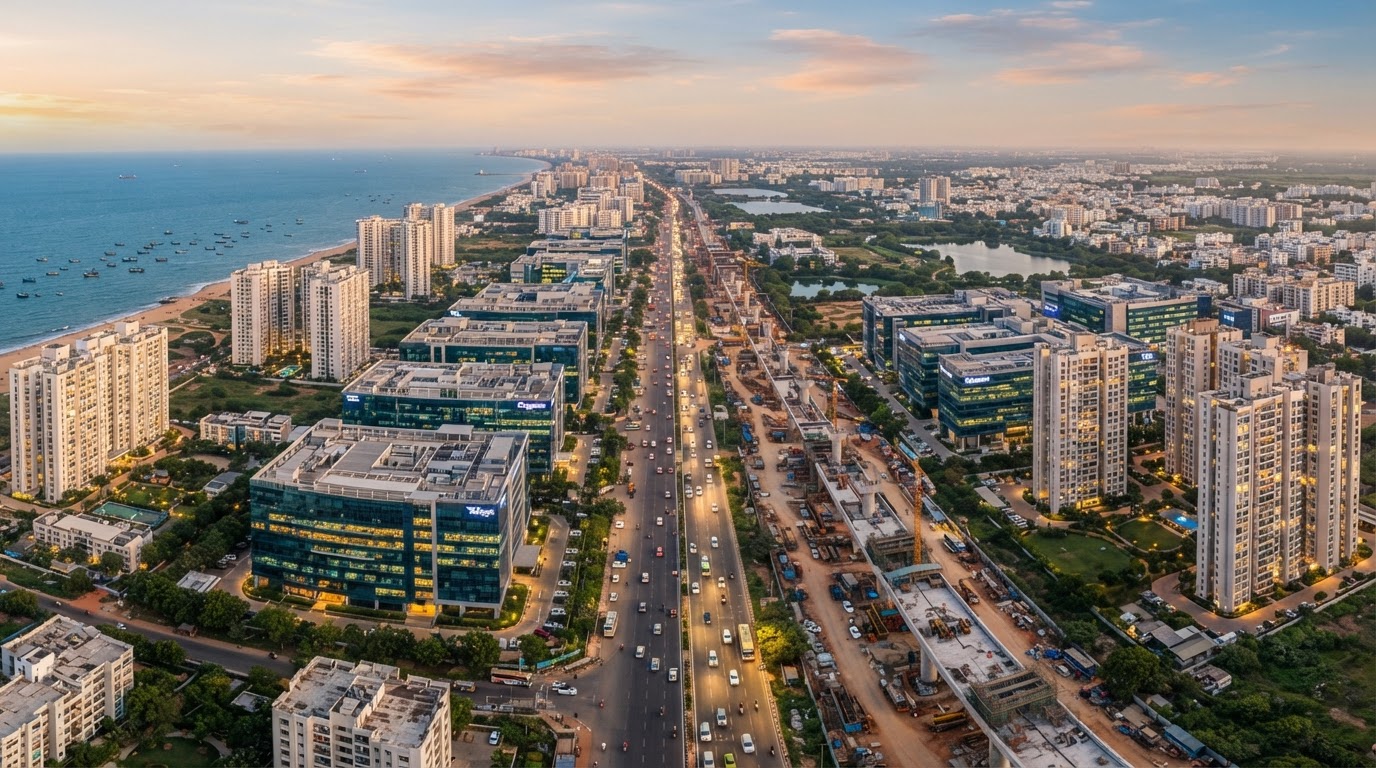
Chennai's Old Mahabalipuram Road (OMR) — the city's primary IT corridor, which houses the campuses of TCS, Infosys, Cognizant, Wipro, and hundreds of other tech firms, is seeing renewed investor interest driven by infrastructure and demand dynamics.
The first wave of OMR development (2005–2015) saw rapid residential construction from Sholinganallur to Navalur, with pricing reaching ₹6,000–8,000/sq ft. By 2018, the corridor was perceived as saturated, and investor attention shifted to other micro-markets.
What's changed:
1. Phase 2 Metro: The Chennai Metro Phase 2 includes a corridor along OMR (from Sholinganallur to Siruseri), which will transform the corridor's connectivity. Pre-launch and under-construction inventory along the metro route is where the appreciation will concentrate.
2. Sholinganallur saturation: The established OMR nodes (Sholinganallur, Perungudi, Taramani) are largely built-out, pushing new development southward to Navalur, Siruseri, and Kelambakkam, where pricing is still at a discount.
3. IT hiring recovery: Chennai's IT sector has seen a hiring recovery in 2025–26, driving end-user demand for residential property along OMR.
4. Affordability: OMR pricing (₹6,000–9,000/sq ft) is 30–40% below Bengaluru and Hyderabad equivalents for comparable IT-corridor micro-markets.
Pricing tiers: - Established OMR (Sholinganallur, Perungudi): ₹7,000–9,000/sq ft - Emerging OMR (Navalur, Siruseri): ₹5,500–7,500/sq ft - Far OMR (Kelambakkam): ₹4,500–6,000/sq ft
The investment thesis: The emerging OMR nodes (Navalur, Siruseri) offer the best risk-adjusted appreciation potential. Entry pricing is at a discount to the established nodes, and the Metro Phase 2 connectivity will narrow the gap. Expected appreciation: 20–30% over a 4–5 year hold.
The risk: Chennai's real estate market has historically been end-user-driven (rather than investor-driven), which means lower speculative demand but also more stable pricing. The appreciation velocity is slower than Bengaluru, but the downside protection is stronger.
Our view: OMR's second wind is a legitimate opportunity, particularly in the emerging nodes. The Metro Phase 2 catalyst, the IT hiring recovery, and the affordability discount to other IT corridors create a multi-driver thesis. For investors seeking a stable, lower-risk South Indian allocation, Chennai OMR is a compelling choice.
Want these insights delivered before anyone else?
Join our confidential investor briefing — subvention alerts, off-market deals and market intelligence, first.
More from Market Insights
Why Whitefield Is Bengaluru's Top Micro-Market for 2026 Appreciation
Metro connectivity, IT corridor saturation and a supply crunch are pushing Whitefield capital values into double-digit growth.

The Hyderabad ORR Growth Corridor: Where Capital Is Headed Next
Beyond Kokapet and Tellapur, the next Hyderabad appreciation zone is forming along the western ORR.
Dwarka Expressway: The NCR Corridor Finally Delivering on Its Promise
After years of delay, the Dwarka Expressway is live — and Dwarka-side Gurugram inventory is repricing fast.