
Rental Yield vs Capital Appreciation: Which to Optimize For?
Yield gives you steady income. Appreciation gives you wealth creation. The optimal strategy depends on your cash flow needs and risk profile.
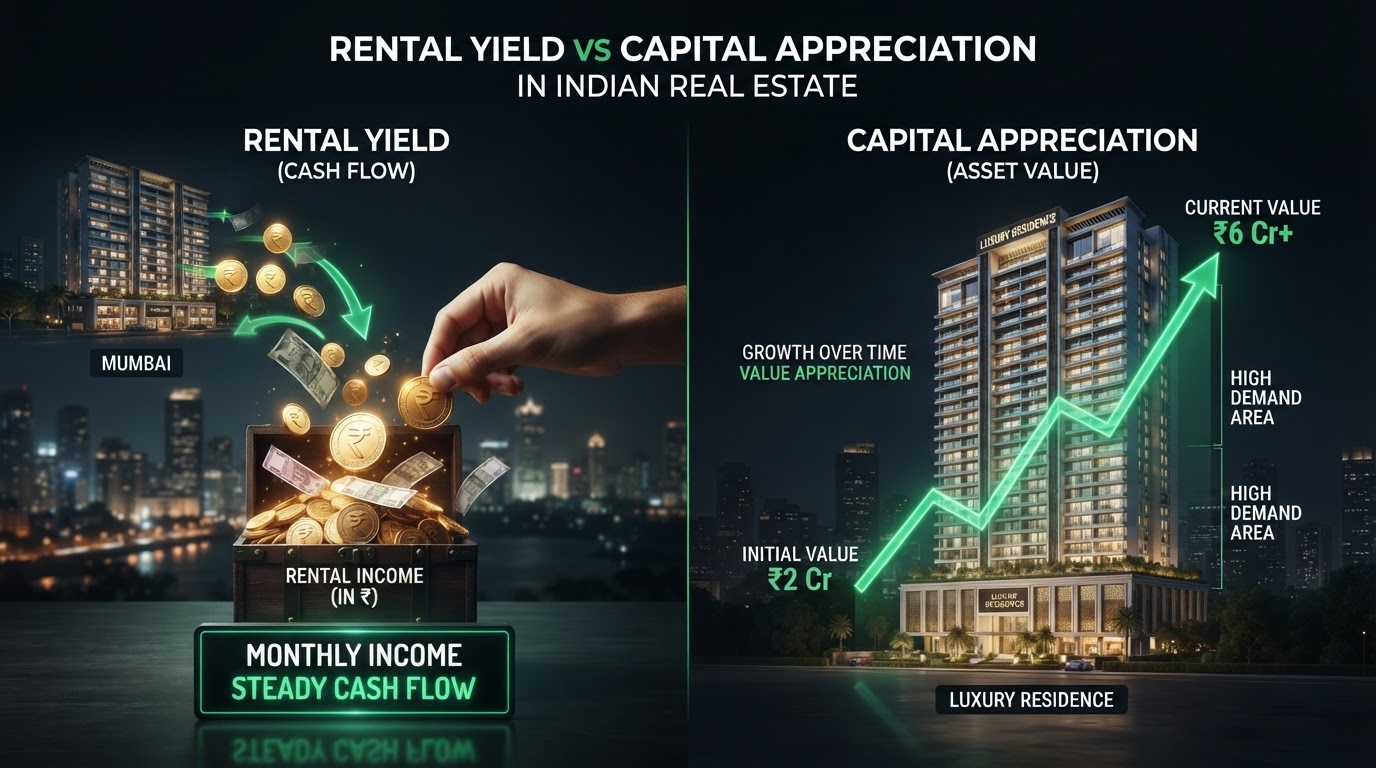
The yield-vs-appreciation debate is the most fundamental question in real estate investment strategy. Both are valid objectives, but they lead to different property choices, different micro-markets, and different holding strategies. Here's our framework for deciding which to optimize for.
Rental yield:
Rental yield is the annual rent divided by the property value, expressed as a percentage. Indian residential yields are typically 2–4%, commercial yields are 6–9%.
Yield-focused investing suits investors who need regular income — retirees, family offices with income distribution requirements, or investors who want the property to service its own loan.
The properties that optimize yield: - Commercial office (Grade-A): 6–9% yield - Ready-to-move residential in IT corridors: 3–4% yield - Student housing and co-living: 5–8% yield
The trade-off: yield-focused properties typically have lower appreciation. Commercial office in established belts appreciates 5–8% annually (versus 15–20% for pre-launch residential in emerging corridors).
Capital appreciation:
Appreciation-focused investing suits investors who want wealth creation and don't need current income — professionals in their earning years, investors with surplus capital, or investors who are building a retirement corpus.
The properties that optimize appreciation: - Pre-launch and under-construction residential in emerging corridors: 20–35% appreciation over 3–5 years - Land/plots in infrastructure corridors: 25–50% appreciation over 5–7 years - Tier-2 city residential with employment catalysts: 15–25% appreciation
The trade-off: appreciation-focused properties typically have low or zero yield during the holding period (under-construction property generates no rent).
The total return framework:
The sophisticated approach is to optimize total return (yield + appreciation), not one in isolation. A property with 3% yield and 15% appreciation delivers 18% total return — competitive with a 8% yield, 8% appreciation commercial property (16% total return), with different risk and liquidity profiles.
Our framework: - For income-focused investors: 60% yield-focused (commercial, ready-to-move), 40% appreciation-focused (under-construction residential). - For wealth-creation-focused investors: 70% appreciation-focused (pre-launch residential, land), 30% yield-focused (commercial or REITs for diversification). - For balanced investors: 50/50 split, with the yield sleeve providing income and the appreciation sleeve providing growth.
The key insight: yield and appreciation are not mutually exclusive. The best portfolios have both — the yield sleeve provides stability and income, while the appreciation sleeve provides growth. The allocation depends on the investor's cash flow needs, risk profile, and time horizon.
Want these insights delivered before anyone else?
Join our confidential investor briefing — subvention alerts, off-market deals and market intelligence, first.
More from Investment Strategy

How Investor Syndication Unlocks Wholesale Developer Pricing
One investor gets retail pricing. Ten investors syndicated through us get wholesale. Here's the mechanics of bulk-buying power.

REITs vs Physical Property: Where Should the Smart Money Go?
Indian REITs offer liquidity and yield, but physical property offers leverage and appreciation. We compare the two.

How Indian Family Offices Are Allocating to Real Estate in 2026
Family offices are shifting from pure equity to real estate for yield, inflation hedge, and generational wealth. We break down the allocation framework.