
FAQ: Are There Hidden Charges in Property Purchase?
Beyond the base price, expect stamp duty, GST, registration, legal, and miscellaneous charges. Here's the complete cost breakdown.
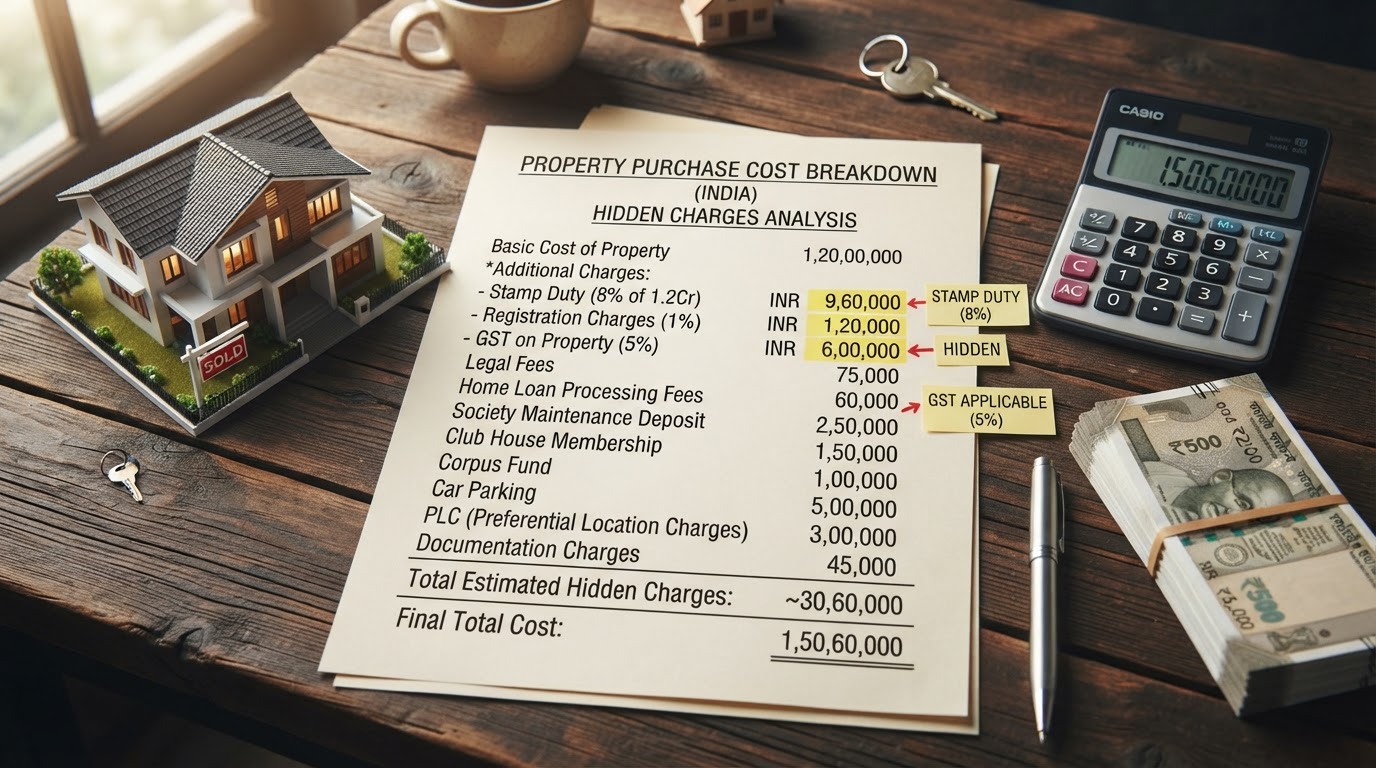
The advertised price of a property is rarely the final price you pay. There are several additional charges — some mandatory, some discretionary — that can add 12–20% to the base price. Knowing these upfront prevents budget overruns.
Mandatory charges:
1. Stamp duty: 4–8% of the property value, varying by state and gender of the buyer. This is the largest additional cost.
2. Registration charges: 0.5–1% of the property value, paid to the sub-registrar for registering the sale deed.
3. GST (under-construction only): 1% for affordable housing, 5% for regular residential, 12% for commercial. Not applicable on ready-to-move property.
4. Legal and documentation: ₹15,000–50,000 for title verification, sale deed drafting, and legal opinion. Engage an independent lawyer — don't rely on the builder's lawyer.
Builder charges (often in the agreement, sometimes overlooked):
5. Preferential location charges (PLC): A premium for specific units — corner units, park-facing, higher floors, or units with special views. Typically ₹100–500 per square foot.
6. Clubhouse and amenity charges: A one-time payment for access to the clubhouse, gym, pool, and other amenities. Typically ₹1–5 lakh.
7. Car parking: Open, stilt, and covered parking slots are charged separately. Covered parking can cost ₹3–10 lakh per slot.
8. Corpus fund: A one-time contribution to the society's maintenance corpus, typically ₹1–3 lakh. This is held in a fixed deposit and the interest is used for major repairs.
9. Maintenance advance: 12–24 months of maintenance charges paid upfront. Typically ₹2–5 per square foot per month, so for a 1,500 sq ft apartment, this could be ₹36,000–90,000 per year.
10. Electricity and water connection charges: ₹25,000–75,000 for permanent connections.
11. Interior fit-out deposit: Some builders charge a refundable deposit (₹25,000–1 lakh) during the interior work period, to cover potential damage to common areas.
12. Home loan processing fee: 0.25–0.5% of the loan amount, charged by the bank.
Total impact: For a ₹1 crore under-construction property in Bengaluru, the additional charges typically total ₹12–18 lakh — stamp duty (₹5 lakh), registration (₹1 lakh), GST (₹5 lakh), PLC (₹2–5 lakh), clubhouse (₹2 lakh), parking (₹5 lakh), and miscellaneous (₹1–2 lakh). That's a 12–18% premium over the base price.
Our rule: always ask the builder for an 'all-inclusive cost sheet' that lists every charge. Compare the all-inclusive price across projects, not just the base price per square foot. The base price comparison can be misleading if one builder has higher PLC, parking, and amenity charges.
Want these insights delivered before anyone else?
Join our confidential investor briefing — subvention alerts, off-market deals and market intelligence, first.
More from FAQs
FAQ: What Is Builder Subvention and Is It Safe?
Builder subvention lets you pay a small percentage upfront and the rest at possession with zero interest. We explain how it works and the risks to watch.

FAQ: How Much Down Payment Do I Need for an Under-Construction Property?
Down payment requirements vary by payment plan and builder. We break down the typical percentages and how to minimize your upfront outflow.
FAQ: Can an NRI Buy Agricultural Land in India?
No. Under FEMA rules, NRIs and OCIs cannot purchase agricultural land, farmhouses, or plantation property in India. Here's what they can buy instead.