
FAQ: How Does Indexation Work in Capital Gains Tax on Property?
Indexation adjusts your purchase price for inflation, reducing your taxable capital gain. Post-Budget 2024, the rules have changed. Here's the current framework.
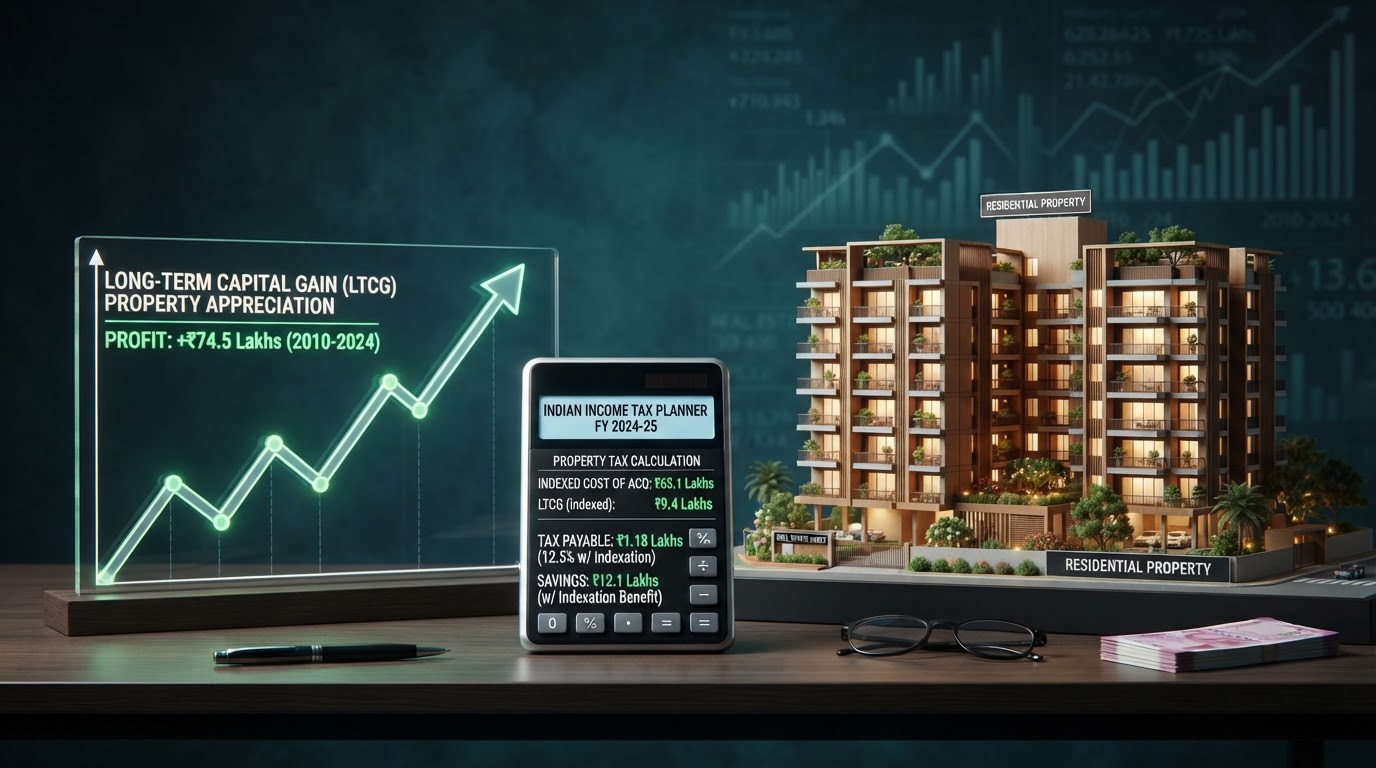
Indexation is a mechanism that adjusts the purchase price of an asset for inflation, reducing the taxable capital gain. It was a significant tax benefit for real estate investors — but the rules changed dramatically with the Union Budget 2024.
How indexation worked (pre-Budget 2024):
For Long-Term Capital Gains (LTCG) on property held for more than 24 months, the purchase price was 'indexed' using the Cost Inflation Index (CII) published by the CBDT. The indexed (inflation-adjusted) purchase price was:
Indexed purchase price = Original purchase price × (CII of sale year / CII of purchase year)
The capital gain was then calculated as: Sale price − Indexed purchase price − Transfer expenses.
The LTCG was taxed at 20% (with indexation).
This significantly reduced the tax burden. For example, if you bought a property for ₹50 lakh in 2015 (CII 254) and sold it for ₹1.5 crore in 2024 (CII 363), the indexed purchase price would be ₹50 lakh × (363/254) = ₹71.4 lakh. The taxable gain would be ₹1.5 crore − ₹71.4 lakh = ₹78.6 lakh, taxed at 20% = ₹15.7 lakh. Without indexation, the gain would be ₹1 crore, taxed at ₹20 lakh.
The Budget 2024 change:
The Union Budget 2024 (effective 23 July 2024) made a significant change to LTCG taxation on real estate:
- The LTCG tax rate was reduced from 20% (with indexation) to 12.5% (without indexation).
- For properties purchased before 1 April 2001, the taxpayer can choose the fair market value as of 1 April 2001 as the purchase price (without indexation benefit on that FMV).
- For properties purchased on or after 1 April 2001 but before 23 July 2024, the taxpayer can choose between: (a) 12.5% without indexation, or (b) 20% with indexation — whichever is more beneficial. This 'grandfathering' provision protects existing investments.
- For properties purchased on or after 23 July 2024, the rate is 12.5% without indexation.
Practical impact: For most properties held for a long period (10+ years), the 20% with indexation option may still produce a lower tax than 12.5% without indexation, because the indexation benefit is substantial over long holding periods. For shorter holds (2–5 years), the 12.5% without indexation is typically better.
Our advice: always calculate both options for properties purchased before 23 July 2024 and choose the one that minimizes tax. Consult a tax professional for your specific situation.
You can also save LTCG tax entirely by reinvesting the gain in another residential property under Section 54, or in 54EC bonds (up to ₹50 lakh).
Want these insights delivered before anyone else?
Join our confidential investor briefing — subvention alerts, off-market deals and market intelligence, first.
More from FAQs
FAQ: What Is Builder Subvention and Is It Safe?
Builder subvention lets you pay a small percentage upfront and the rest at possession with zero interest. We explain how it works and the risks to watch.

FAQ: How Much Down Payment Do I Need for an Under-Construction Property?
Down payment requirements vary by payment plan and builder. We break down the typical percentages and how to minimize your upfront outflow.

FAQ: Can an NRI Buy Agricultural Land in India?
No. Under FEMA rules, NRIs and OCIs cannot purchase agricultural land, farmhouses, or plantation property in India. Here's what they can buy instead.