
FAQ: What Is the Difference Between a Subvention Plan and a CLP?
Both defer payments, but the mechanics and costs are very different. Here's a clear comparison to help you choose the right plan.
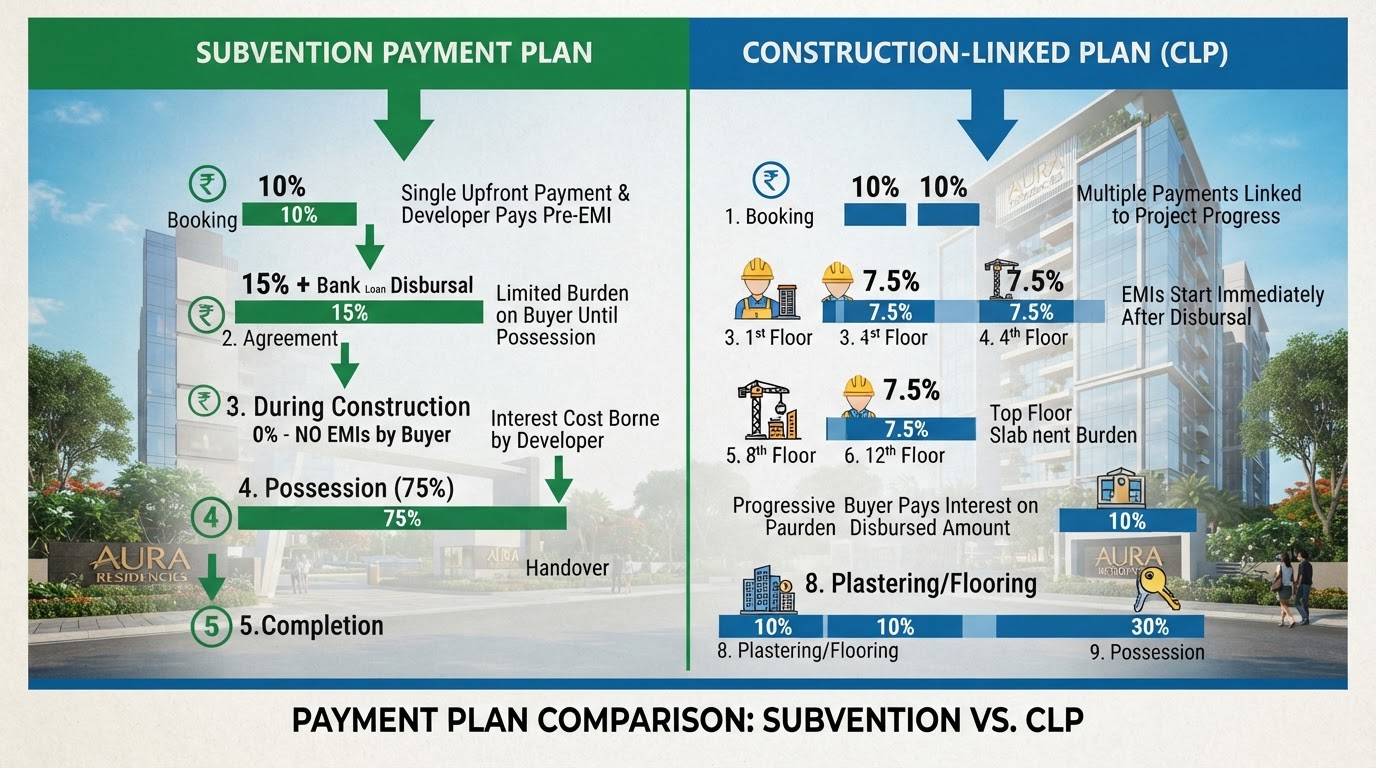
Subvention and Construction-Linked Payment (CLP) plans are both designed to defer payments during construction, but they work very differently and suit different investor profiles.
Subvention Plan:
- You pay a small percentage at booking (typically 10–25%). - You pay nothing more until possession. - The builder carries the balance interest-free. - No bank loan, no EMI, no interest during construction. - At possession, you pay the remaining 75–90% — either from your own funds or by taking a home loan at that point.
The advantage: minimal capital outflow during construction, zero interest cost, and maximum ROI on invested capital. The disadvantage: the full balance falls due at possession, which requires a large lump-sum payment or a home loan at that time.
Construction-Linked Payment (CLP) Plan:
- You pay 10–15% at booking. - The remaining amount is paid in installments tied to construction milestones — typically 10 payments of ~8–10% each, triggered at excavation, foundation, each floor slab, brickwork, plastering, flooring, fittings, and possession. - If you're self-funding, you pay each installment from your own pocket as construction progresses. - If you're taking a home loan, the bank disburses each installment directly to the builder, and you pay pre-EMI (interest only on the disbursed amount) until full disbursement.
The advantage: payments are spread across the construction period, so the cash outflow is gradual. The disadvantage: you're paying throughout construction (not deferring to possession), and if you're using a loan, you're paying interest from the first disbursement.
Key comparison:
| Feature | Subvention | CLP | |---|---|---| | Upfront payment | 10–25% | 10–15% | | Payments during construction | None | Milestone-based | | Interest cost during construction | Zero | Pre-EMI on disbursed amount (if loan-funded) | | Balance at possession | 75–90% | 10–15% | | Best for | Investors who want to minimize capital outflow and maximize ROI on invested capital | Investors who want to spread payments and are comfortable with gradual outflow |
Which to choose? For investors focused on maximizing ROI on invested capital, subvention is superior — your money at risk is minimal, the interest cost is zero, and the appreciation accrues on the full property value. For investors who prefer gradual payment and don't want a large lump-sum at possession, CLP is the safer, more predictable option.
Our recommendation: if you qualify for a subvention plan on a RERA-registered, tier-1 developer project, take it. The ROI advantage is significant. Use CLP as the fallback if subvention isn't available.
Want these insights delivered before anyone else?
Join our confidential investor briefing — subvention alerts, off-market deals and market intelligence, first.
More from FAQs

FAQ: What Is Builder Subvention and Is It Safe?
Builder subvention lets you pay a small percentage upfront and the rest at possession with zero interest. We explain how it works and the risks to watch.

FAQ: How Much Down Payment Do I Need for an Under-Construction Property?
Down payment requirements vary by payment plan and builder. We break down the typical percentages and how to minimize your upfront outflow.

FAQ: Can an NRI Buy Agricultural Land in India?
No. Under FEMA rules, NRIs and OCIs cannot purchase agricultural land, farmhouses, or plantation property in India. Here's what they can buy instead.