
Power of Attorney for NRI Property: What It Can and Cannot Do
A POA is essential for NRI property transactions, but its scope is limited. We explain what a POA can and cannot authorize.
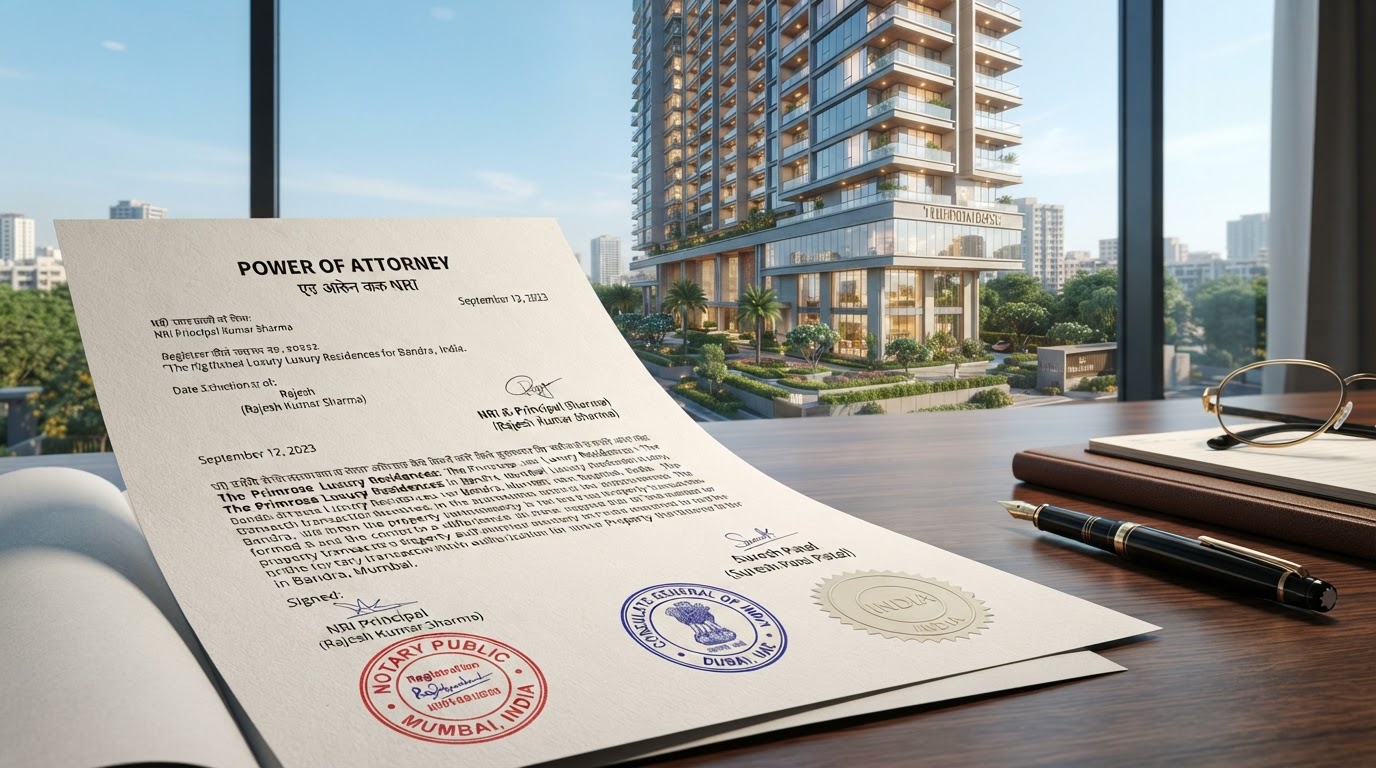
The Power of Attorney (POA) is an essential tool for NRI property transactions, allowing a trusted representative in India to act on the NRI's behalf. But the POA's scope is legally defined, and understanding its limits is critical to avoid invalid transactions. Here's what a POA can and cannot do.
1. What a POA can authorize:
A property-specific POA can authorize the POA holder to:
- Execute the sale agreement and register the property on behalf of the NRI. - Apply for and obtain necessary approvals and documents (RERA registration, OC, CC). - Interact with the developer, bank, and municipal authorities. - Sign loan documents and interact with the bank on the NRI's behalf. - Collect rent and manage the property (for rental properties). - Pay property tax, maintenance, and other property-related dues. - Engage legal, architectural, and repair services for the property. - Represent the NRI before the sub-registrar, RERA authority, and municipal corporation.
2. What a POA cannot authorize:
A POA cannot authorize the POA holder to:
- Sell the property without the NRI's explicit consent (unless the POA specifically includes sale authority, which is rare and risky). - Gift the property (gifting requires the owner's personal execution in most cases). - Use the property as collateral for the POA holder's own loan. - Transfer the property to the POA holder's name.
The general principle: the POA authorizes administrative and transactional acts, but not acts that transfer ownership or create encumbrances without the NRI's explicit consent.
3. Types of POA:
- General POA (GPA): Authorizes the holder to act on behalf of the NRI in all matters. This is broad and risky — we do not recommend a GPA for property transactions. - Special POA (SPA): Authorizes the holder for a specific transaction or set of acts (e.g., purchasing a specific property, managing a specific rental). This is the recommended type for NRI property transactions. - Property-specific SPA: The most secure — authorizes the holder only for a specific property, with clearly defined powers.
4. Creating a valid POA:
For an NRI, the POA must be:
1. Drafted: By a lawyer, specifying the property, the authorized acts, and the POA holder's details. 2. Printed: On non-judicial stamp paper (if executed in India) or plain paper (if executed abroad). 3. Notarized: By a notary in the NRI's resident country. 4. Attested: By the Indian consulate/embassy in the resident country. This is mandatory — a POA notarized abroad but not attested by the consulate is not valid in India. 5. Adjudicated: Within 3 months of receipt in India, the POA must be adjudicated by the local sub-registrar (who verifies and registers it, charging a stamp duty).
5. The POA holder:
The POA holder is typically a trusted family member (parent, spouse, sibling) or a professional (CA, lawyer). The key criteria: - Trustworthiness: The POA holder has significant authority, so they must be completely trustworthy. - Availability: They must be available in India to execute the required acts. - Competence: They should understand the property transaction and be able to interact with developers, banks, and authorities.
6. The risk of POA misuse:
POA misuse is a real risk in Indian real estate. A POA holder with broad authority can potentially: - Sell the property without the NRI's knowledge (if the POA includes sale authority). - Mortgage the property for their own loan. - Collect rent and not remit it to the NRI.
Mitigation: - Use a property-specific SPA, not a GPA. - Do not include sale authority unless absolutely necessary (and if included, require the NRI's written consent for each sale). - Monitor the property and the POA holder's actions regularly (check property records online, verify rent credits). - Revoke the POA when it's no longer needed (e.g., after the property is registered and the loan is disbursed).
7. Revoking a POA:
A POA can be revoked by the NRI at any time, by executing a revocation deed and registering it with the sub-registrar. The revocation must be communicated to the POA holder and to all parties who have dealt with the POA holder (the developer, the bank, the tenant).
Our advice: use a property-specific Special POA, drafted by a lawyer, notarized and attested by the consulate, and adjudicated in India. Choose a trustworthy POA holder, and limit the POA's scope to the specific transaction (purchase, loan, registration). Do not grant sale authority unless absolutely necessary. Revoke the POA once the transaction is complete. The POA is a powerful tool, but its power must be carefully bounded to protect the NRI's interests.
Want these insights delivered before anyone else?
Join our confidential investor briefing — subvention alerts, off-market deals and market intelligence, first.
More from NRI Investing

NRI Investors Are Quietly Buying Bengaluru Again — Here's Why
Rupee depreciation, RERA maturity and tech-corridor yield are pulling Gulf and Singapore-based NRIs back into Bengaluru.

NRI Real Estate Investment: The Complete FEMA Compliance Guide
NRI property investment in India requires specific FEMA compliance. We cover the rules, accounts, repatriation, and tax implications.

NRI Property Taxation: The Complete Guide
NRI property taxation is complex — TDS, capital gains, surcharge, and repatriation rules all apply. Here's the complete framework.